"
By the steadfast practice of Kriya and Meditation the sleeping serpent, Kundalini, hisses softly in the Sushumna. It pierces all the Chakras and Anahata Nada is heard. That splendid sound absorbs your mind in no time.
-- Bipin Joshi
Shiva Vidya and Ajapa Gayatri Teacher
Importance of Kriya and Meditation in your life
If you are wondering how Kriya and Meditation can be put to use for the betterment of your professional and personal life read on.
In modern world our lives are evaluated on the basis of two things - success and happiness. No matter who we are we always want to be successful. A beggar and a businessman both want to be successful at what they are doing. The same goes with happiness. We all want to be happy. We know that sorrow is part and parcel of human life but we still want to avoid it. We want to run away from it. We want to embrace happiness... unending happiness. That's our natural instinct.
The idea of success varies from person to person. For a worldly minded person success may mean money and luxuries. And for a spiritual minded person success may mean detachment and spiritual unfoldent. The same can be said about happiness too. Your idea of happiness and someone else's idea of happiness might be totally different. Whatever contradicts our idea of happiness, we try to avoid it.
The question is - How many of us are able to fulfill our own ideas of success and happiness? How do we approach our ideas of success and happiness? How do we prepare and train ourselves to attain our life goals?
In their quest of being successful and happy people often prepare themselves superficially. They may acquire cutting edge professional skills, they may acquire excelent soft skills, they may attend motivational and leadership workshops and so on. Yet the fact is many can't attain what they aspired for.
Consider the following real life situations:
- A person is looking for a job change. He has managed to acquire all the technical skills and experience needed for the switch. He is quite satisfied with the interviews. Yet some unknown happens and he doesn't get selected for his dream position.
- A person loves to watch motivational and inspirational videos on YouTube and other sources. While watching those videos he feels motivated and inspired. But after a while the motivation disappears. He is again overpowered by laziness and inertia.
- A person is called "successful" and "happy" by his friends and relatives. But if asked in private he confesses that he thinks of himself as an unsuccessful and unhappy person.
- A person has everything - money, wife, kids, and luxuries - yet he is feeling void and occasionally wants to run away from this world into the Himalayas.
- A person wants to learn some new cutting edge technology. But he finds that his focus, grasping and understanding is no longer the same as he used to have in his early days.
- A person sets some fitness goals, joins a costly gym but after a few weeks fails to maintain the same level of enthusiasm.
- A person finds information overloading - books, blogs, websites, Facebook, Twitter, WhatsApp, videos, news channels, smart gadgets - too overwhelming and can't focus on his work or life in general.
Sounds familiar? Does that happen to you or your friends? I am sure many of you can relate these situations to your life. They are so common. Why do people fall in the same trap again and again? Why do they suffer in spite of having all the necessary resources? And what's the solution?
Yogic answer to these problems is this - Life Energy (in yogic terms we call it Prana Shakti or Prana). The Life Energy inherent to your Being. The quality of your life is decided by the quality of your Life Energy. Whatever you do in life or aspire to do in the future all depend on your vital life force. Remember, the Life Energy has a very deep and subtle meaning in Yoga. So, don't take that by its face value. It goes far deeper that what you can even imagine at this stage.
The Life Energy manifests itself in five chief forms namely:
- Ichha Shakti or will-power
- Dnyana Shakti or power to know
- Kriya Shakti or power to act
- Nigraha Shakti
- Anugraha Shakti
The first three are primarily responsible for your day to day life (be it material or spiritual). The last two are more important for your spiritual unfoldment and I won't discuss them here.
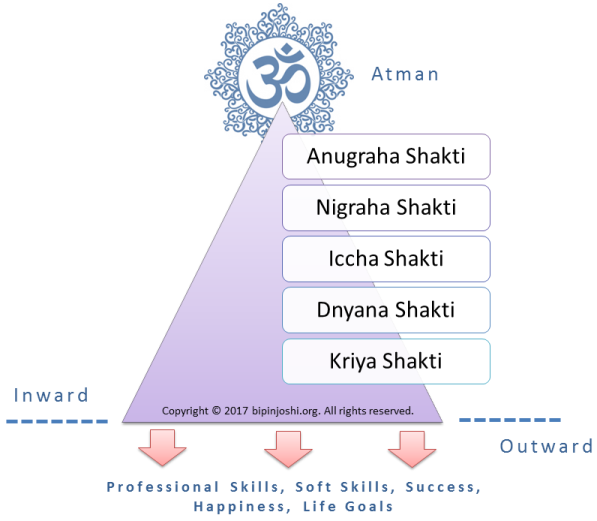
Now take a deep breath and ponder over any task you recently completed. How did you finish the task? First, the desire to do that task arose in your mind. Your Iccha Shakti was strong enough to and led you to seek knowledge as required to do that task. Your Dnyana Shakti then gathered all the necessary knowhow required for the process. Finally, your Kriya Shakti actually put that knowledge into action.
Now think what could happen if any of these three energies are weak. If Iccha Shakti is weak you will easily succumb to laziness, inertial or other priorities of life. If Dnyana Shakti is weak you will keep craving for the task but won't find a way to do it. If your Kriya Shakti is weak you will have everything needed to complete that task, yet you won't do it.
Repeat this exercise with a few more tasks you completed in your life and also with a few tasks that you couldn't complete. You will now understand and appreciate the significance of these energies.
Now let's take this to next level. What if you wish to fine tune, enhance and strengthen these three energies? That's what Yoga allows you to do.
Yoga is an art and science of fine tuning energies inherent to human beings.
If you learn to take care of these inherent energies you can excel at anything in your life.
If you learn to control and fine tune these energies you can attain your life goals much more easily.
What's more, Yoga enables you to unlock the huge reservoir of dormant energy (in yogic terms it's called Kundalini Shakti or Mahaprana) that can then be put to use for spiritual transformation.
You then understand the real purpose of human life beyond the worldly boundaries.
Here, it must be noted that although practiced widely Yoga Postures is just a small part of the classical Ashtanga Yoga system of India. The eight limbs of classical Yoga are - Yama, Niyama, Asana, Pranayama, Pratyahara, Dharana, Dhyana and Samadhi. As you can see Asana or Yoga Postures is just a small part of the whole story. Far more important are behavioural, pranic, and meditative limbs of Yoga.
More and more individuals are realizing that mere material pleasures are not making them happy.
Inspite of having all sorts of material luxeries at their disposal they experience a feeling of voidness.
And then they wish to explore the spiritual world to figure out the purpose of life and to taste the divinity within.
Yoga is an indispensable tool for such aspirants.
Yoga is not a magic. It requires discipline, patience, sincerity and faith.
But if you walk that path you will realize it's all worth investing.
Difficulties will still be there but now you have trained your mind-body equipment to overcome them.
To that end the powerful sequence of Mantra, Pranayama, Hand Mudras and Meditation taught on this website will empower you to take control of your Life Energy and thus your life.
Now that you are familiar with the role Yoga can play in your life, read about a few important and time proven benefits of Kriya and Meditation here.